I remember the first time a piece of content I worked on dropped out of the top ten despite being technically “better” than the competitor ranking above it – better writing, more depth, cleaner structure, more backlinks. It made no sense on paper. And then, slowly, it made complete sense.
The page that outranked mine wasn’t just about the topic. It was about the topic in a way that connected to everything around it – related concepts, adjacent questions, the whole semantic landscape of the subject. My page was a good answer to a specific question. Their page was part of a coherent knowledge structure. That’s a different thing entirely.
That was my real introduction to semantic SEO. Not as a technique but as a way of thinking about content.
What Semantic SEO Actually Is
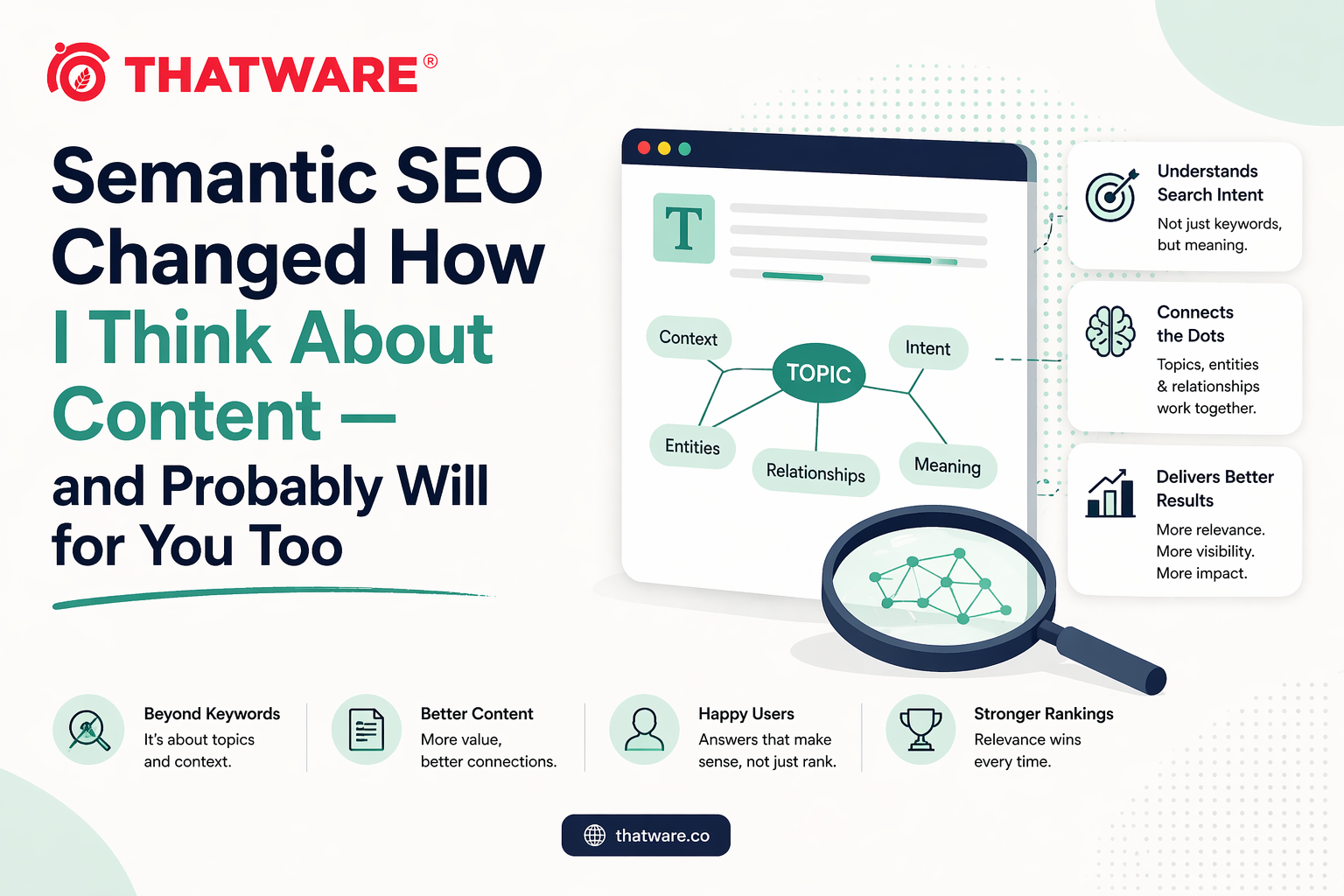
Semantic SEO is the practice of optimizing content for meaning and context rather than just keyword matching. It’s about understanding the relationships between concepts, entities, and ideas – and creating content that reflects those relationships in ways that search engines can recognize.
Google’s ability to understand meaning – not just match strings – has evolved dramatically over the last decade. BERT, MUM, and now generative AI integrations have changed how the search engine interprets queries and evaluates content. It’s no longer enough to have the target keyword in the right places. The question is whether your content demonstrates genuine understanding of a topic, including the concepts that surround it.
That sounds abstract. In practice, it means thinking about topics, not just keywords. It means creating content that covers a subject with the depth and breadth of someone who actually knows the material – not just someone who knows what words to include.
On the horizonEcommerce SEO Services: Driving Multi-Million Dollar Organic Revenue for Shopify, WooCommerce & Enterprise Stores
The Entity Angle
One of the most important shifts in modern SEO is the move from keyword-based indexing to entity-based understanding. Google’s Knowledge Graph is essentially a giant map of entities – people, places, things, concepts – and the relationships between them.
When you write about a topic, Google isn’t just looking at the words on the page. It’s trying to understand which entities you’re talking about, how they relate to each other, and whether the overall semantic structure of your content aligns with what it knows about those entities.
This is why semantic seo services often focus heavily on entity optimization – making sure that the concepts in your content are clearly defined, correctly related, and aligned with how authoritative sources represent those same topics. It’s a different kind of technical work, and it requires a different kind of expertise.
On the horizonHow to Use a Backlink Marketplace Without Damaging Your SEO
The Practical Shift in Content Strategy
Here’s what changed for me practically when I started thinking semantically about content. Instead of starting with a keyword and writing backward from it, I started with a question: what is the complete landscape of this topic, and what would a genuinely comprehensive treatment of it look like?
That means identifying the main entity or concept, the subtopics that are closely related, the questions that naturally arise when someone is learning about the subject, the adjacent concepts that provide context, and the terminology that experts use versus the language that beginners use. A semantic content strategy maps all of that before writing a word.
The result is content that covers a topic in a way that feels complete – not just long, but genuinely thorough in the way that a good encyclopedia entry feels thorough. And that’s exactly what search engines have been trying to reward for the last several years.
On the horizonBefore You Fix Your Water, You Should Probably Understand It First
Why Depth Beats Frequency
There used to be a school of thought that publishing frequently – lots of content, lots of keywords, lots of pages – was the key to SEO. Some people still operate this way. It’s becoming increasingly wrong.
What semantic SEO has revealed is that depth beats frequency almost every time in modern search. A site with 50 genuinely comprehensive, semantically rich pieces of content will outperform a site with 500 shallow posts targeting individual keywords. Google can tell the difference. And increasingly, so can users.
The investment logic here is actually favorable. Creating 50 pieces of genuinely excellent content is more resource-intensive per piece than producing 500 mediocre ones, but the total investment is comparable – and the results compound over time rather than decaying.
On the horizonThe Kind of Water You Don’t Think About—Because It Just Works
Tools and Techniques
The practical toolkit for semantic SEO has matured considerably. Topic modeling tools can help identify the conceptual clusters around a subject. Entity analysis tools can surface the key entities that should appear in content about a given topic. Competitive semantic analysis can show you what neighboring concepts your competitors are covering that you’re not.
Working with a good semantic seo agency means having access to these tools and the analytical capability to use them well – but more importantly, having strategists who understand how to translate semantic insights into content decisions. The tools are only as useful as the thinking behind them.
A Different Relationship with Search
What semantic SEO ultimately did for how I think about content is this: it shifted the goal from “ranking for keywords” to “being a genuinely authoritative source on a topic.” Those aren’t the same thing, and when you aim for the latter, the former tends to follow.
On the horizonA Roof You Don’t Think About Is Usually a Good One
That reframing is worth sitting with. The best content strategy isn’t the one that reverse-engineers ranking signals most cleverly. It’s the one that most thoroughly serves the genuine informational needs of the people you’re trying to reach. Semantic SEO just happens to align those two things better than any approach that came before it.
That’s not a coincidence. It’s probably intentional.